=================
First Things First: A Preface To This Blog Post Which Will Seem Tangential At First But Will Become Relevant as You Read On
February is American Heart Month Here are two great ways to commemorate the occasion:
–Learn Hands-Only CPR; you never know when it might help you save a life! (Also, you may know that there are lots of playlists featuring songs with tempos of 100-120 bpm, which help maintain the correct compression rate for Hands-Only CPR. And since it’s in the news currently, here’s a fun fact: Kendrick Lamar’s “Not Like Us” is among them.)
–Encourage your workplace to purchase and install an automated external defibrillator (AED), and train its employees to use it, and make sure everyone knows where it’s located. Also, when you’re out and about — at the store, the library, the mall, or any public place, really — note whether or not the place you’re in has an AED. If it doesn’t, ask them if they’ll consider purchasing and installing one. They save lives!
Now on to the blog post.
===================
On the evening of February 9, 2020, I was well-nigh bristling with unaccustomed confidence and excitement.
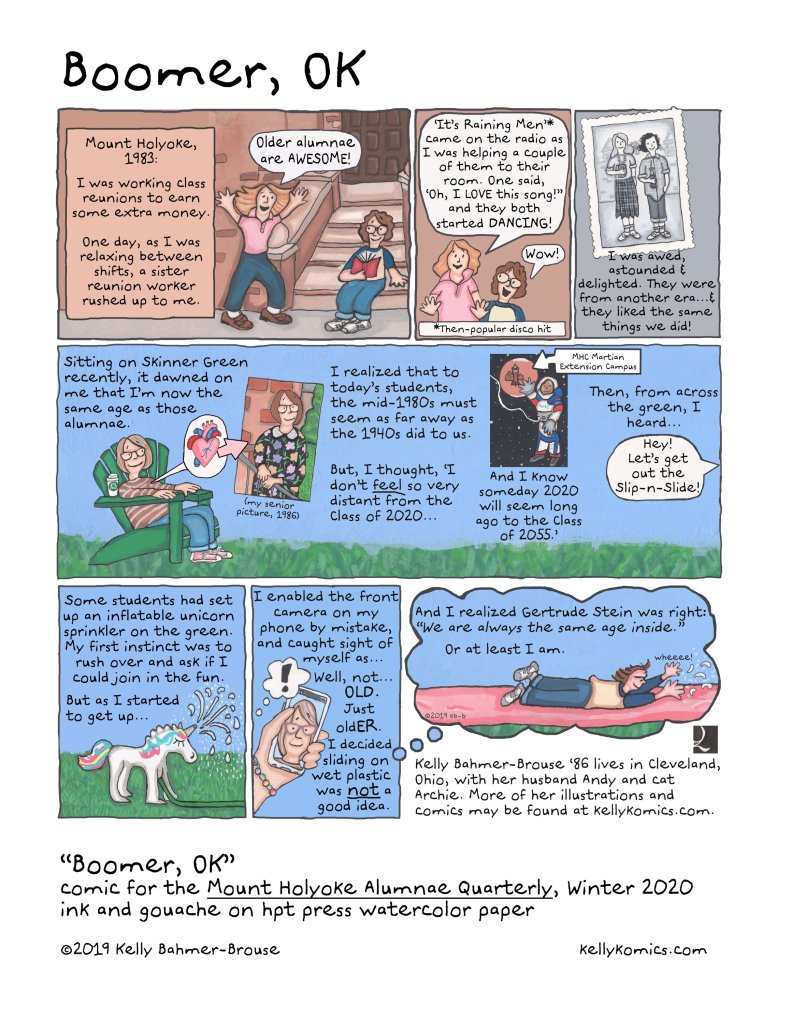
For the first time in nearly 35 years– the last time my regular comic strip appeared in The Mount Holyoke [College] News — I was about to have a cartoon appear in print. The editor of the Mount Holyoke Alumnae Quarterly commissioned me to create a comic for its winter issue, on a topic of my choice! And the Quarterly would pay me for it!
I would finally be a real — or “real” — cartoonist!
And I couldn’t wait to share the comic. But even though the comic went live on the Quarterly‘s website in late January 2020, I wanted to wait and post it here on the blog and on social media once the physical issue started arriving in people’s mailboxes.
To fill the time, I started sketching out a series of comics on aging; some would serve as a prelude to the AQ comic, some as a kind of continuation.
I finished the first one early on the morning of February 10th, 2020 and uploaded it to WordPress; the time stamp reads 2:35AM.
I went to bed feeling excited not to mention (atypically) organized and prepared. When the Alumnae Quarterly arrived, I’d be ready to share my new work!

But then less than six hours later, an early morning phone call literally altered every plan I’d made for that Monday, and many days and weeks afterward:
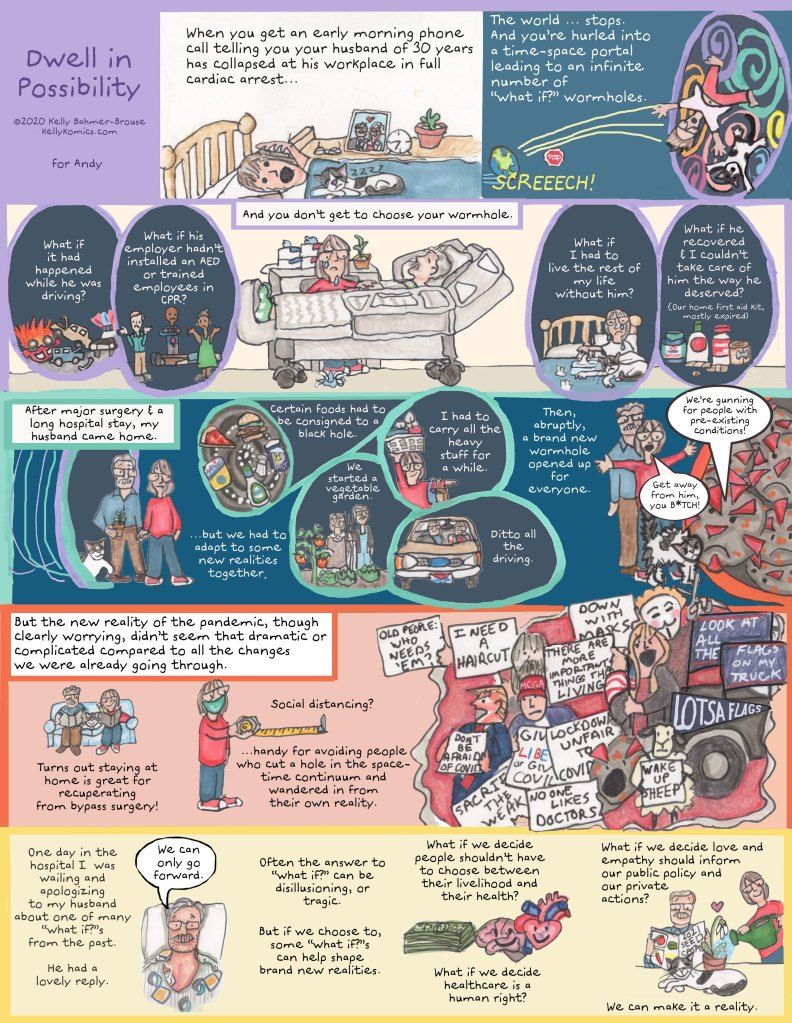
There are some artists who can create comics under any circumstance, no matter how fraught, or disastrous. (I’m thinking especially of Brian Fies and his graphic novel A Fire Story; which began as an online comic describing Fies losing his house and everything he owned during the 2017 California wildfires. He “went to Target the day after the fire and bought shoes. I bought socks and a shirt because I’d evacuated [with]out those things… I bought a spiral bound book of really terrible drawing paper because this is what Target had for art supplies. And I bought a couple Sharpies and four color highlighters, and I started drawing. I started drawing our story of the day after the fire because I knew I needed to get this out. I need to get out in the world. I need to tell people our story.”)
I admire these artists who can forge ahead no matter what.
But I am not one of them.
After a day of confusion and fear– after a day of talking to admissions staff and ER nurses and ICU nurses and resident doctors and cardiologists and lab technicians — after sitting for hours in the weird, unrelenting, glowing gray-yellow light of my husband’s hospital room, watching flashing lights on monitors and listening to the insistent beeps of machines — after going to my husband’s workplace and searching the large parking lot for our car — after sitting in our car in the dark and weeping for a long time — after calling my husband’s family to tell them what had happened …
I came home from the hospital late that night to find my copy of the Mount Holyoke Alumnae Quarterly in our mailbox.
And it seemed so very unimportant.
Moreover, addressing the subject of advancing age — and its quiet partner, the concept of mortality — no longer appealed. It seemed frivolous. It even seemed unlucky, as if I’d invited catastrophe into our lives. (Over-the-top, I know, but at that point, my thinking was not very logical.)
About 10 days later, I did listlessly share the “OK, Boomer” comic with my friends, and some Mount Holyoke alum groups, via Facebook — mainly, I think, to distract myself, and try to occupy a few of the interminable minutes in that hospital room.
But I didn’t share it more widely.
I didn’t share the “Aging Disgracefully” comic anywhere, and, consumed with other responsibilities, didn’t continue work on the other comics I’d planned in the series.
To be honest, it wasn’t just everything surrounding the day-to-day of my husband’s recovery that derailed my comics.
For a long time, everything about Monday, February 10, 2020 was etched in excruciatingly sharp relief in my mind, as if it were a floodlit theater stage where even the shadows had sharp edges. It’s only been within the last year or so that my first thought upon awakening every day isn’t a full-on 3-D In Living Color flashback to That Morning.
For me, these comics are indelibly intertwined with that day, and — I know this is weird — I’ve tried to avoid thinking or even looking at them as much as possible in the intervening years.
But now it’s five years later. My husband is well and healthy. Even his bypass surgery scar has almost completely faded. His cardiologist says Andy’s recovery and subsequent progress is miraculous. The cardiologist was offering a general assessment, but he was also literally correct.
In a statistic I am grateful I didn’t know until well after Andy’s cardiac arrest, it turns out that the mortality rate for cardiac arrests occurring outside of a hospital setting is over 90%. That Andy is among the 10% who survive sure seems like a miracle to me.
Miracles, though, sometimes benefit from human help. The foundation of Andy’s miracle rests on the fact that Andy’s workplace has multiple AEDs installed in its facility and — in the same way some workplaces have employees serve as volunteer fire marshals to oversee fire drills — has a dedicated first aid team of employees trained in CPR and AED use.
So, like I said at the beginning: learn hands-on CPR. Persuade your workplace to install an AED, and teach their employees to use it.
Thanks for reading. I’m going to go give Andy a hug and kiss, and then finally go make some more comics.

 Kelly Komics
Leave a comment